Metal painting
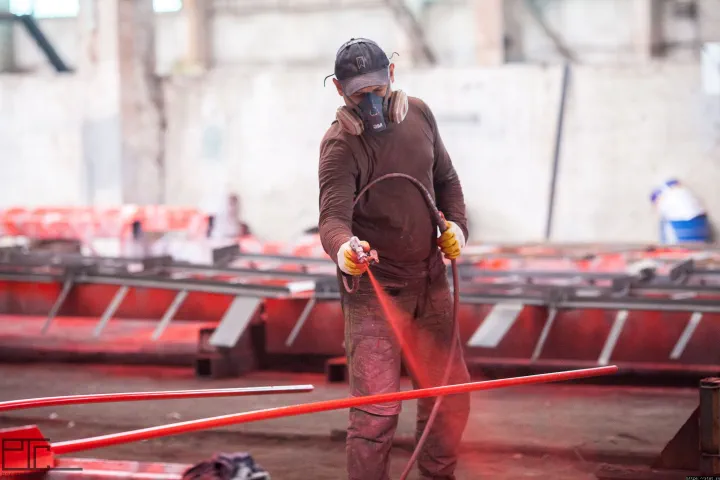
Metal painting is one of the most common types of finishing work. It gives the surface an attractive appearance while protecting it from corrosion and other environmental effects.
Professional applications increasingly use powder coating. This is one of the most popular and practical ways to paint metal products, producing a high-quality finish with excellent durability.
Advantages of powder coating
The main challenge in painting metal products is applying an even, high-quality layer to a complex shape. With conventional paint, recesses and cavities often remain poorly coated. Powder coating eliminates this problem.
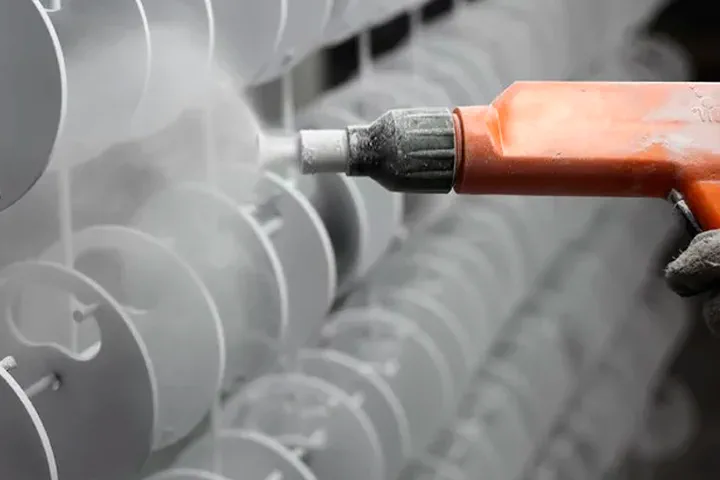
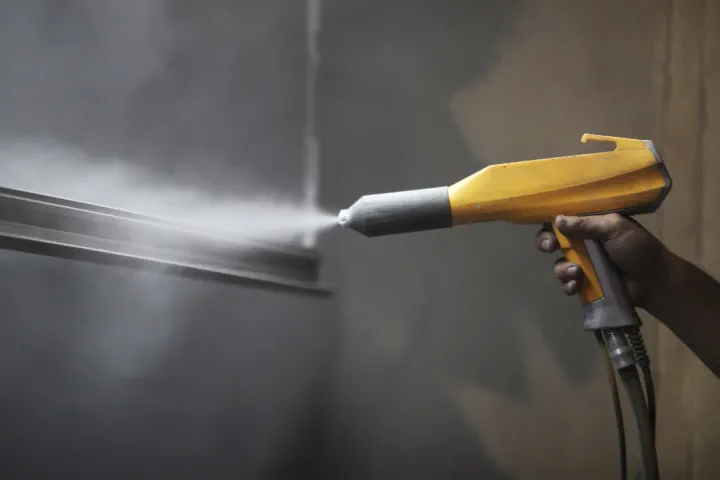
Electrically charged powder particles adhere easily even in the most remote corners of a complex structure. The structure is carefully prepared and given a charge opposite to that of the paint particles.
Why choose our metal painting service
High-quality professional metal painting protects against corrosion and extends the service life of metal products.
1
Painting products of different shapes
We can paint metal products of different shapes and sizes to meet your requirements.
2
Modern equipment
We use modern equipment and high-quality paint from established brands.
3
Extensive experience
For more than 10 years, we have provided metal painting for our own production needs and to order.
Powder coating provided by Ivanovo Mechanical Plant is one of the most effective ways to protect metal surfaces from corrosion and other aggressive environmental effects. The durable coating also creates an attractive appearance, resists dirt, and is easy to clean. Powder coating is popular for parts and structures because it is reliable, durable, and available in a wide range of shades.
Powder coating technology
Powder coating involves applying a thin layer of finely dispersed powder and then melting it at a temperature of +200°C. The resulting film bonds securely to the structure of a metal, glass, or other surface. The coating compound consists of multiple components, primarily thermosetting or thermoplastic polymers. The components are homogenized and the cooled melt is then crushed into fine particles.
Advantages and limitations
Compared with conventional liquid coatings, powder coating offers the following advantages:
- High adhesion to the substrate provides a long service life.
- Uniform coverage regardless of the blank configuration or surface texture.
- Environmentally responsible process using components that are safe for people and the environment.
- Powder is used with minimal waste, no more than 4%. By comparison, liquid coating losses can reach 40%. Particles that do not reach the surface can be used for the next layer.
- The durable layer offers high resistance to impacts, scratches, temperature changes, acids, and other aggressive substances and factors.
- The coating can be applied within 1.5–2 hours without labor-intensive preparation.
Limitations of powder coating
Powder coating requires specialized equipment. The mixture is melted in chambers heated from +150 to +220°C, which makes it unsuitable for plastic or wood parts. Achieving a uniform color can also be difficult when powders of different shades are mixed.
Types of powder coatings
Depending on the manufacturing technology, powder coatings are classified as follows:
- Polyester. Mixtures based on carboxyl-containing polyesters are commonly used for facades, fences, and aluminum-profile structures.
- Epoxy. Because of their low UV resistance, these coatings are used to protect surfaces not exposed to sunlight, such as warehouse racks, drying drums, and equipment.
- Hybrid. Mixtures of polyester and epoxy components offer improved properties and versatile applications.
- Polyurethane. Thanks to their high strength and resistance to aggressive effects, polyurethane coatings are used for wheels, household-appliance housings, production equipment, and tractor and automotive parts.
We can process metal surfaces with different types of paint and finish. Options include smooth surfaces, coarse orange-peel textures, fine-grained Moiré finishes, antique-style finishes, wood effects, hammered finishes, and more.
Application methods and equipment
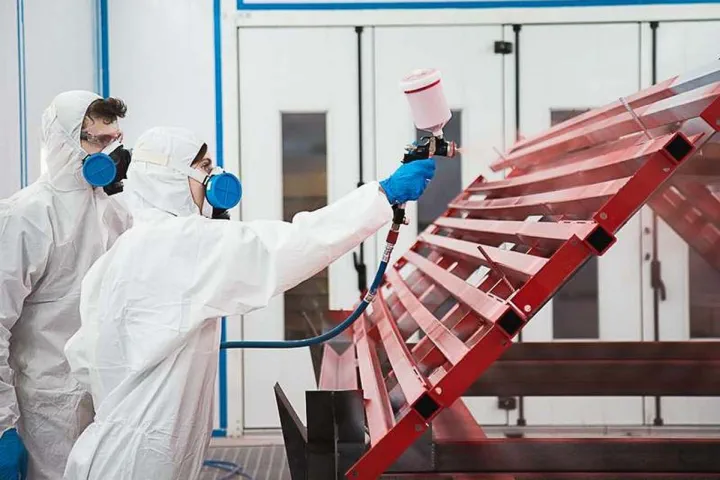
Our production facilities allow powder coating by electrostatic spraying or by a directed air or flame stream generated by spray guns with integrated propane burners. Products are processed on modern lines equipped with powder-application chambers, electrostatic sprayers and compressors, curing booths, conveying equipment, and other systems.
Coating process
Powder coating is performed in three stages. First, the surface is cleaned, degreased, and phosphated. Areas that are not to be painted are masked. The powder is then applied and cured. Finally, the protective coating hardens as it cools.
We provide painting services for all types of metal, including steel, in Moscow, Ivanovo, Kostroma, Yaroslavl, Vladimir, and the surrounding region.